Jijide: Scent as a Space for Dialogue
Written by Eveline Nagajeva
Founded in 2016 in Milan, Jijide approaches perfumery as a form of dialogue – between cultures, between people, and between inner worlds.
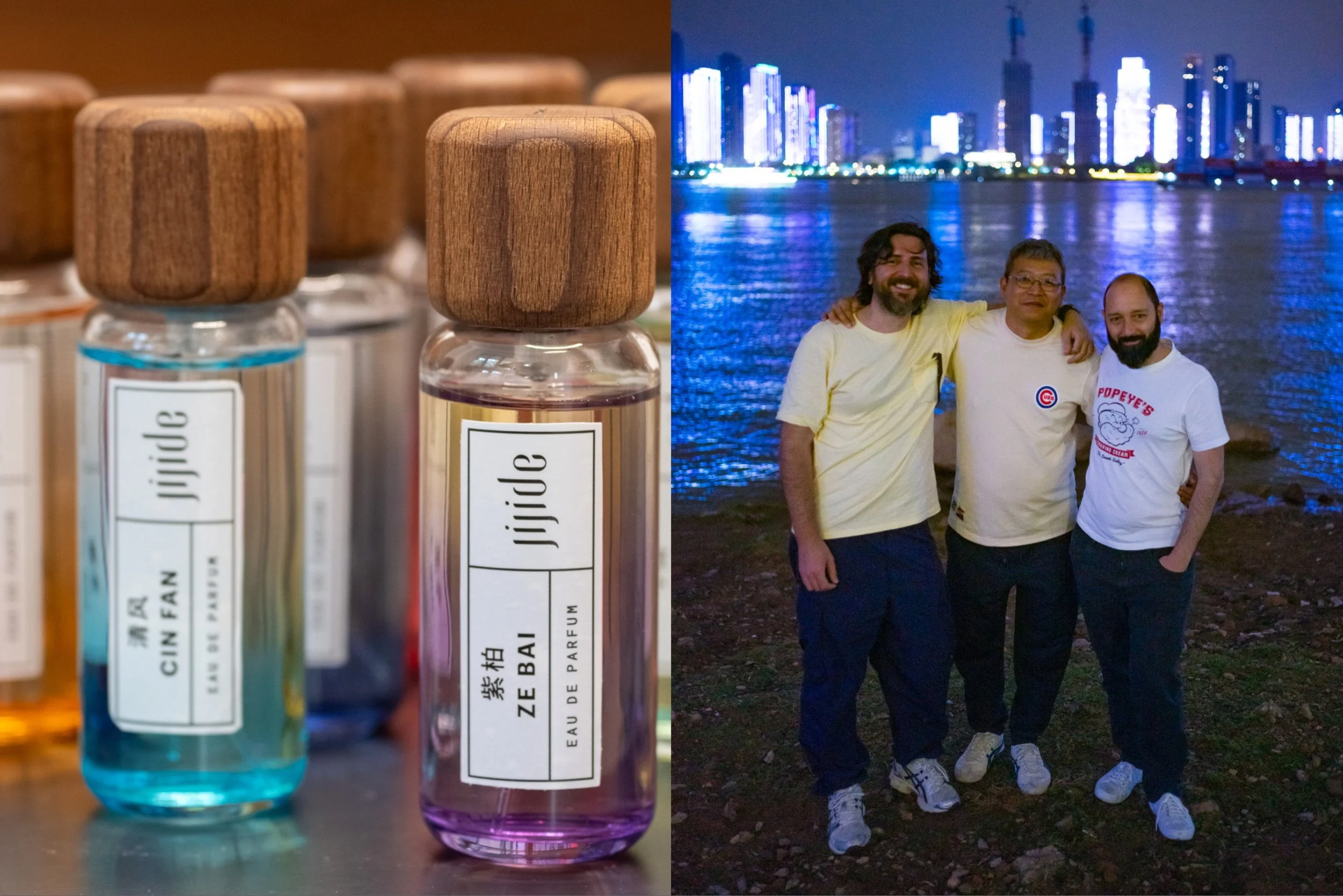
The founders of Jijide / Images provided by the brand
When exploring the brand in preparation for this interview, it quickly became clear that Jijide is deeply conceptual at every level, from the founding idea to the final packaging. In a time when perfumery often seems more focused on trends and commercial success than on artistic expression, Jijide appears guided by concept rather than calculation.
Curious to understand the philosophy behind the brand, we spoke with Jijide’s co-founder, Adam James Cavallari.
Jijide was born from conversations between you and your friends. Could you share the story of how the idea first emerged? What was missing in the perfume world that made you feel Jijide had to exist? Were there any personal moments or memories that shaped the brand at its origin?
The story of Jijide begins with a discovery made in China exactly ten years ago: the realization that, for the new generation, perfume had become a tool of self‑affirmation and, in many ways, emancipation. In a culture where body fragrances are not traditionally widespread, we witnessed something striking: fragrance was not being used to mask or decorate, but to declare. It had become an expressive medium, an identity statement.
That encounter reshaped our perspective. We understood that perfume, more than any spoken introduction, arrives before we do. It precedes us and presents our way of being to the world with a silent but powerful clarity.
At the same time, we noticed a profound absence in the perfume landscape: no one was truly connecting fragrance to the broader portrait of today’s world, a world shaped by diverse cultures, ethnicities, languages, and customs that coexist, overlap, and often create the new precisely through their intersections.
Jijide was born from this intuition. We exist to tell the story of encounters between differences, and to explore how, when these differences genuinely connect, they generate unexpected beauty. Perfume became our chosen medium to narrate that dialogue.
The union of Italian and Chinese cultures as the foundation of the brand is quite unusual. Why did you choose this direction? And how challenging is it to combine two very different cultural worlds into one unified concept?
Our choice to build Jijide on the union of Italian and Chinese cultures is, in truth, a very natural one because we are half Italian and half Chinese. We are friends who have known each other for twenty years, and the brand is, before anything else, the expression of that long-standing relationship: an exchange made of encounters, contrasts, and dialogue that over time has created harmony and enriched our inner worlds.
Bringing two very different cultures together is never effortless. It would be naïve to pretend that common ground exists in every aspect of life. But we’ve learned that respect for individuality, for difference, for the unique sensibilities each of us carries, is the foundation on which not only coexistence is possible, but genuine enrichment.
Jijide is born exactly there, in that in‑between space where identities meet without needing to merge, where contrast becomes complement. For us, the union of Italy and China is not a conceptual exercise; it is the living reflection of who we are, and of a friendship that continues to evolve by embracing difference rather than flattening it.
Do you notice differences in how Jijide is perceived in Europe versus Asia? Are tastes different? Are certain fragrances more popular in one region than another?
Surprisingly, far less than one might expect. The real differences we observe are not so much between Europe and Asia, but between the brands of each region, which often draw inspiration from local habits, symbols, or cultural references.
In a globalized world like ours, however, it has become increasingly rare for taste itself to remain sharply divided along geographic lines. What we do see is a generational shift that cuts across countries. For example, in Asia there has been a clear move toward stronger, more impactful fragrances, something that has now become an established preference among younger consumers. Conversely, in the Middle East, quite unexpectedly, the new generation is showing curiosity for lighter, more original, almost transparent compositions.
So rather than a simple “East versus West” dynamic, we perceive a broader evolution: people are seeking scents that reflect their daily lives rather than their traditional archetypes. In other words, today’s differences are less cultural and more generational; a search for authenticity rooted in the present, not in inherited expectations.
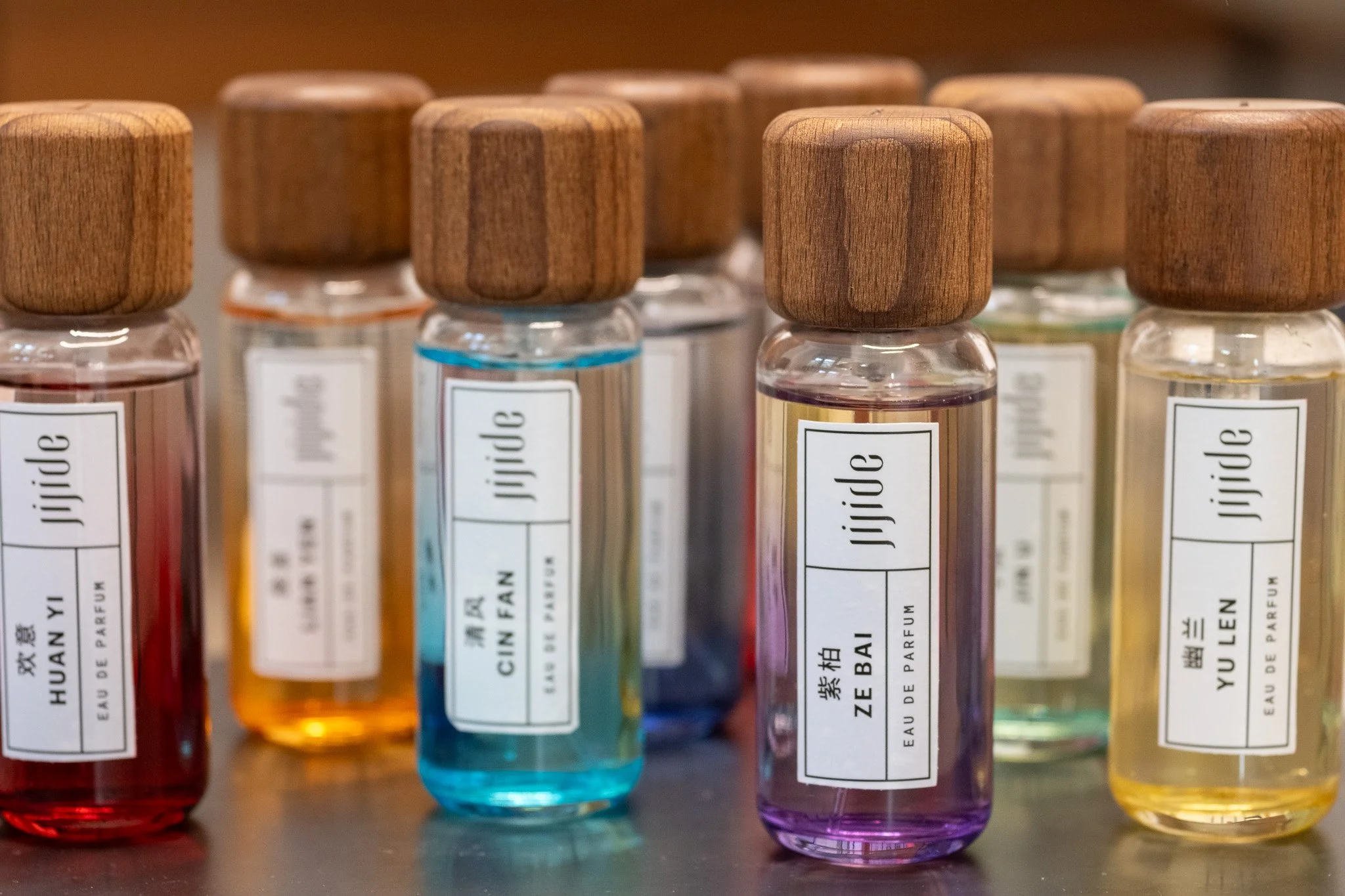
Jijide proudly positions itself as a brand made in Italy, yet with minimal environmental impact. I really appreciate the restrained and eco-minded packaging, it feels thoughtful and modern. And as someone who has definitely kept more than a few beautiful perfume boxes “just in case,” I appreciate not having to feel guilty when it’s time to recycle. This feels like a contrast to the velvet-and-gold opulence often associated with Italian perfumery. Was it your intention to gently rebel against the stereotype that Italian fragrance must be about extravagance and opulence? Do you see Jijide as part of a new generation of Italian brands redefining luxury in a more conscious and understated way?
We see packaging as part of the message, a quiet but precise way to tell people who we are. If we take the literal meaning of “luxury” as “not necessary,” then yes, we intentionally push against that idea. We choose to offer only what is essential so that the true object of desire—the fragrance itself—reaches people with clarity.
For us, the only protagonist is the juice. Everything around it should be stripped of the non‑essential. But more importantly, it should convey responsibility: as makers, we are accountable for what we create and how we create it. That responsibility extends to materials, volume, and the afterlife of every component.
Is this a rebellion against the velvet‑and‑gold stereotype? In a way, yes—though we see it less as provocation and more as coherence. Italian excellence is not only opulence; it is also precision, restraint, and purpose. Jijide belongs to a new wave of contemporary brands, in Italy and beyond, that are redefining luxury as conscious, intentional, and elegantly understated. And in many ways, Jijide does not simply participate in this movement. It helps lead it, setting a clear example of how modern luxury can be both essential and responsible. Our approach has become a reference point for emerging brands that look to Jijide for direction, drawing inspiration from a philosophy where understatement is a choice of integrity.
The aesthetic is quieter, but the values are unmistakably louder.
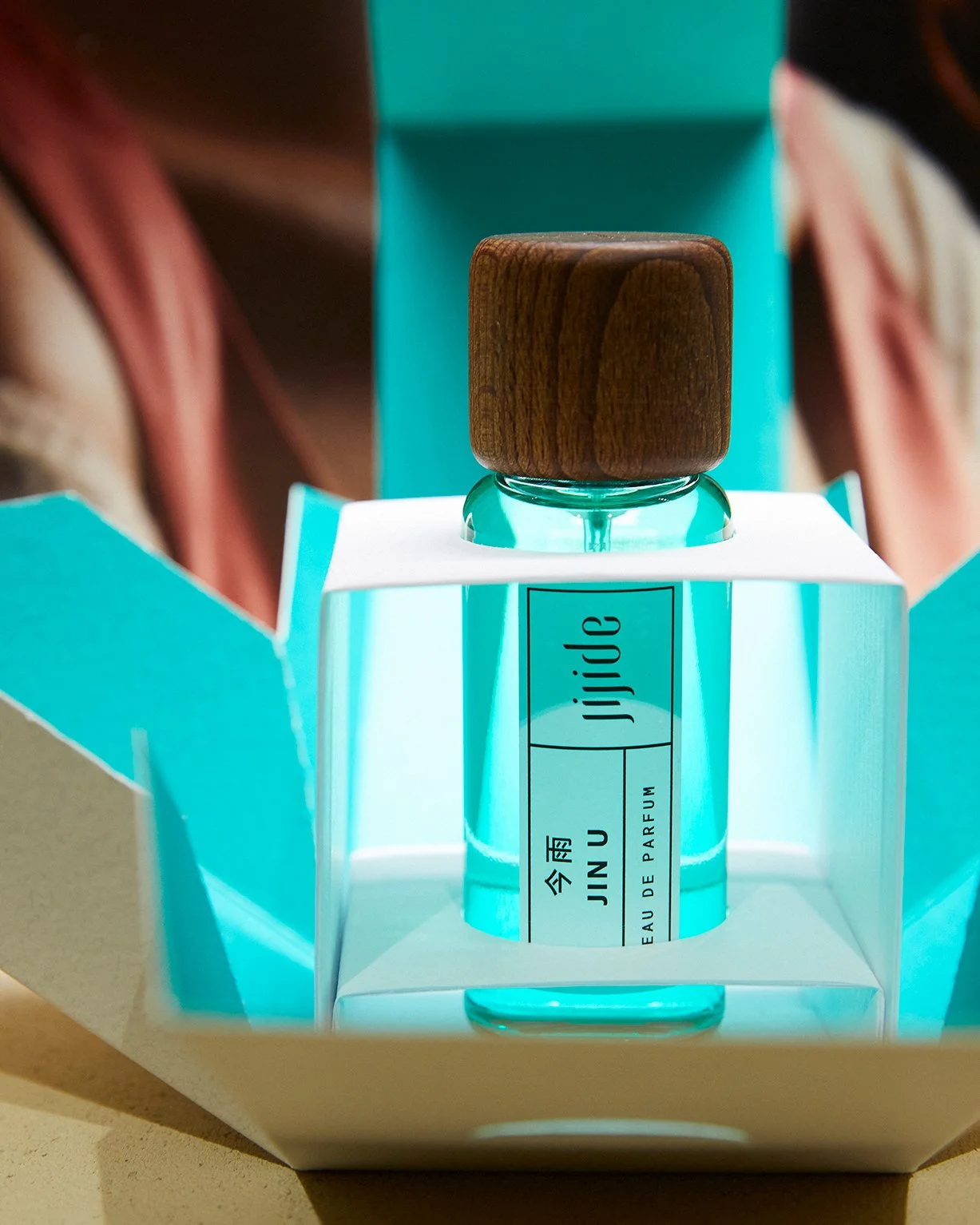
Jijide fragrances feel conceptually layered and thoughtfully constructed. How do these ideas actually come to life? I imagine they are born from intense philosophical conversations about existence or is it sometimes simpler than it appears, with inspiration arriving in unexpected, ordinary moments, perhaps while watching a football match over pizza? How does your creative dialogue transform into a finished fragrance?
Jijide fragrances are born from a very simple yet profound necessity: to bring to light themes that feel urgent, especially for the new generation. Each scent is like an instant photograph of the contemporary world, capturing its moods, anxieties, desires, and questions. And because the world keeps changing, these “snapshots” change with it: every year new ideas emerge, shaped by the cultural and emotional landscape of the moment.
What continues to surprise us is that the young people who work with us rarely want to speak about the topics everyone else is already discussing. Instead, they gravitate toward what is deeply personal to them, subjects that are meaningful, intimate, and often overlooked. They remind us that some of the most important conversations are precisely those that do not make the headlines, the ones that are whispered rather than shouted.
So no, our fragrances are not born only from philosophical debates or abstract concepts. They come from real exchanges with real people. From moments of honesty. From the desire to give voice to those who have something important to say but whose voices often get lost in the noise of an overwhelming world.
Our creative dialogue transforms into a fragrance through this act of listening. A note becomes a metaphor, an accord becomes a point of view, and the final composition becomes a message; one that carries forward the stories, concerns, and quiet revolutions of those who inspired it.
When you start working on a new scent, especially within the Dialogue collection, what comes first a story, an emotion, a cultural reference, or a specific note?
For us, the starting point is always the theme, the subject we want to bring into the conversation. It must feel contemporary, meaningful, and truly representative of the world as it is today. That is the anchor of every creation.
Once the theme is defined, we build a narrative around it, but always in a positive light. We try to craft an image, a scenario, a feeling that expresses the essence of that theme without falling into pessimism or rhetoric. That narrative becomes the conceptual blueprint that guides the olfactory construction.
From there, we translate the story into scent. The ingredients are chosen not only for their aesthetic qualities but because they can symbolically represent elements of the cultural narrative. A note may evoke a place, an attitude, a memory, or a collective sentiment tied to the theme. It’s a highly layered process, and we work with a strong sense of coherence so that the final fragrance reflects the idea with clarity and intention.
Jijide collaborates with young perfumers, what attracts you to rising talents rather than established “star” noses? How does this choice reflect the identity and vision of the brand?
For the Dialogue collection, Jijide collaborates with young perfumers because they embody, in the most authentic way, the very idea we want to share. In the Dialogue collection, where two different cultures come together to speak about a single subject, it feels essential that the creators themselves genuinely represent the contemporary world. Their age, their perspective, and the fact that many of them are working on their first real project are not incidental; they are part of the message.
These young perfumers carry an urgency, a sincerity, and a need to express themselves that cannot be manufactured. They are not interpreting a theme from a distance; they feel it, they live within it, and they understand why it matters today. This immediacy is exactly what allows them to transform a cultural topic into a fragrance that speaks with clarity and emotional truth.
For us, the central value is authenticity. Jijide doesn’t impose a narrative or filter it through an established “star” nose. Instead, we let the protagonists speak directly. Their voices, their sensitivities, their cultural experiences become the fragrance itself.
How do you discover and select the perfumers you work with? What makes you feel that someone is the right match for Jijide?
For us, the selection of perfumers always begins with a human connection. We need to feel that there is a shared sensitivity, a curiosity, a way of looking at the world that resonates with the spirit of Jijide. When that alignment is there—intuitive, unforced, almost immediate—we know the collaboration will lead to the right result.
Technical skills are essential, of course, but it is not what determines the match. What matters most is whether the person understands the deeper purpose of our work: to give voice to contemporary themes and to translate them with honesty. When we sense that someone can bring their own truth, their own cultural experience, and their own emotional intelligence into the process, then we know there’s a match.
Have you ever been surprised by how someone interpreted your fragrances? When writing about fragrances, I often wonder whether my personal associations align with what the creator intended. How do you feel when someone “reads” your scent in a completely different way?
Yes, absolutely, and I genuinely enjoy hearing different interpretations. They are often fascinating. When someone shares an unexpected reading of a fragrance, I tend to dig a little deeper, because those interpretations always reveal something about the person in front of me. Their images, their memories, their emotional associations come from their own experiences and inner world.
I see it as a gift every time this happens. A fragrance is not a fixed message; it’s a conversation, and people inevitably contribute their own language to it. I even admit that, when I let someone smell a scent for the first time, I often intentionally encourage them to share their own view. Their perspective enriches the life of the fragrance—and mine as well.
Is there a fragrance in the collection that you feel was misunderstood? Or perhaps one you expected to become very popular, but it didn’t?
I have to say that all our fragrances are genuinely appreciated. That said, within the latest Dialogue collection, Dentro is certainly the most polarizing.
Some people fall in love with it instantly and intensely—almost obsessively—while others simply cannot tolerate it at all. And that’s perfectly fine. A fragrance that divides usually means it has a strong point of view, and Dentro was never meant to be neutral.
Today many consumers focus heavily on longevity and projection. Do you ever feel pressure to create a so-called “beast mode” fragrance, or would that conflict with Jijide’s philosophy? Have you ever chosen to remove something technically impressive because, emotionally, it did not feel right?
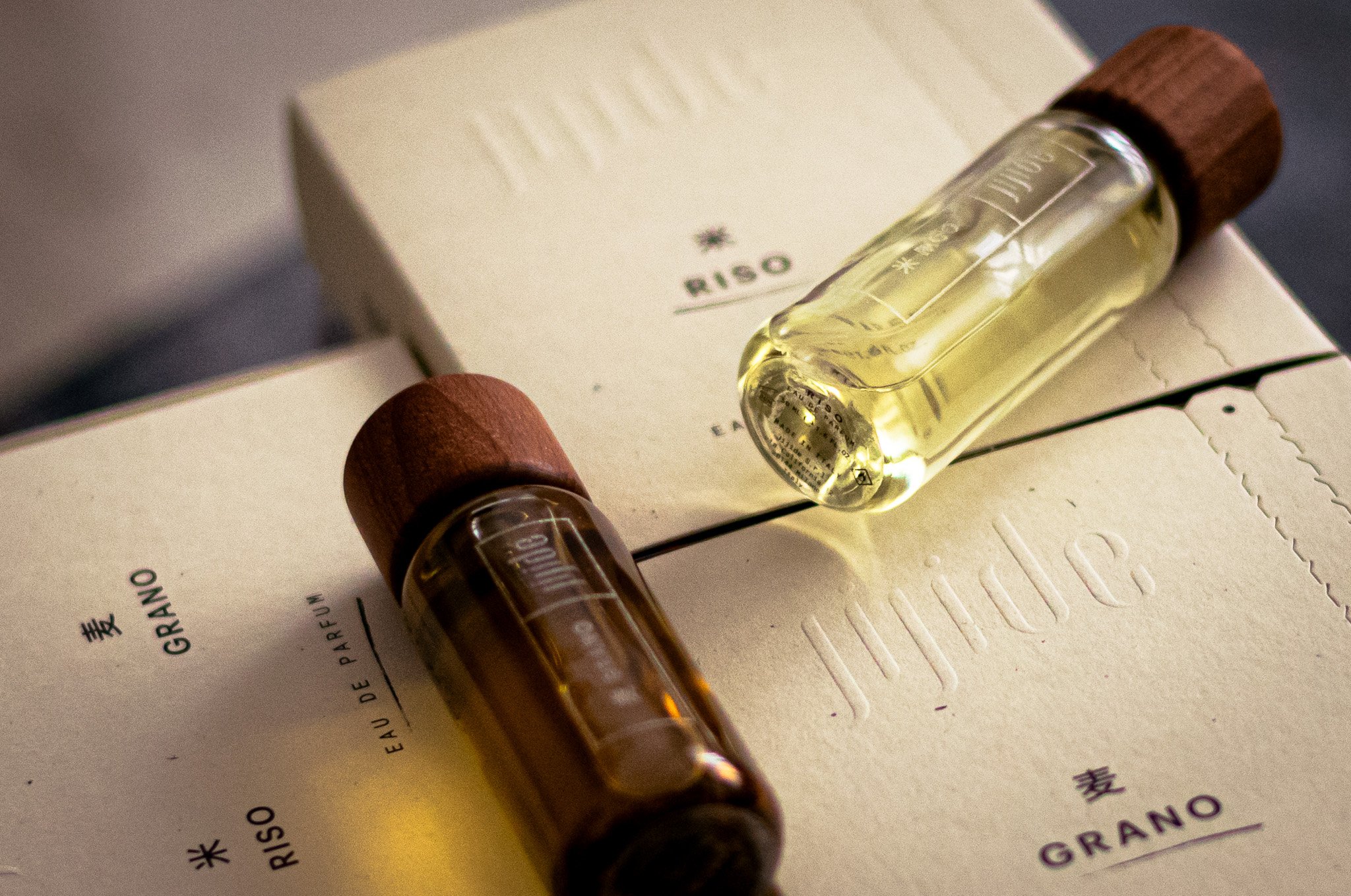
We don’t feel that pressure, and our decisions are never driven by the market. In our collection we certainly have very longlasting fragrances—Dentro, Grano, Terra, Oltre—but their strength comes naturally from the raw materials we chose, not from a desire to create a “beast mode” effect.
We’ve never added or removed something simply to increase power or projection. Our formulations are entirely guided by the narrative behind each fragrance, by the theme we want to explore. And that creative process already shapes the personality of the scent—its volume, its intimacy, its way of taking space.
In other words, technical performance is a consequence, not a target. The story leads, and the fragrance follows.
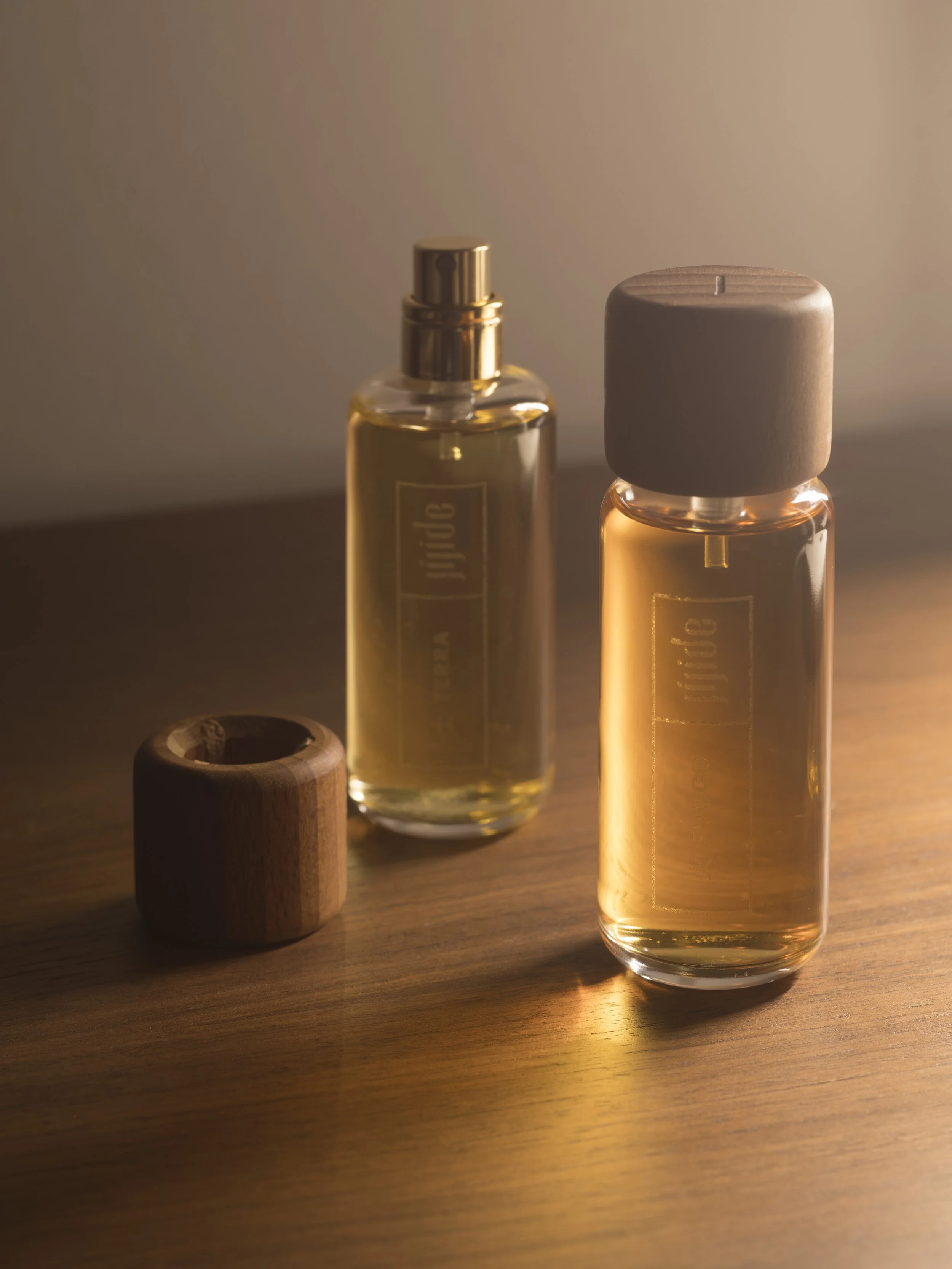
As the industry becomes louder, faster, and more commercial, Jijide feels more reflective and concept driven. How do you stay true to your vision, and what idea or value would you never allow the brand to lose?
It’s true, the industry has become very loud, very fast, and filled with new brands. But not many of them genuinely have something to say. Often, they present what people expect to hear, and that may work once, maybe twice… but then what? A brand can only endure if it has its own voice, and if that voice remains meaningful to the people who choose it.
For us, staying true to our vision means remembering exactly why Jijide exists. Our values—the encounter between cultures, the dialogue between differences, the belief that diversity is a source of enrichment—are not decorative concepts.
They are the foundation of the brand. Without them, Jijide would lose its purpose. These values are nonnegotiable. If you remove them, we lose meaning. And in an industry driven by noise, meaning is the rarest and most precious form of distinction.
What is Jijide focusing on right now? Are there new fragrances, new dialogues, or new creative directions we should look forward to?
Right now, we’ve put the Dialogue collection temporarily aside, and for the past year we’ve been working on a highly experimental and ambitious project. It revolves around the anthropological study of a single raw material, an ingredient that, in our view, has always been underestimated. Our intention is to bring it to the forefront and reinterpret it in a distinctly contemporary way.
It’s a complex project involving several people with very different skills and perspectives, because the goal is not simply to create a new fragrance but to build an entirely new narrative around this ingredient. The result will form the foundation of a completely new and previously unseen collection within Jijide.
Our aim is to launch the new fragrance in September 2026. It will mark a new chapter for us, one that deepens our research, expands our creative language, and continues our commitment to treating perfume as a cultural conversation.