From Stage to Scent: The Avant-Garde Language of FUMparFUM
Written by Kristina Kybartaite-Damule
Aistis Mickevicius is changing the way Lithuania experiences perfume. As the country’s first perfumer to launch his own brand, FUMparFUM, he creates scents that are both conceptual and avant-garde. In an exclusive interview with PlezuroMag, Mickevicius reveals how he turns perfume into wearable art and a medium for communicating his vision of the world.
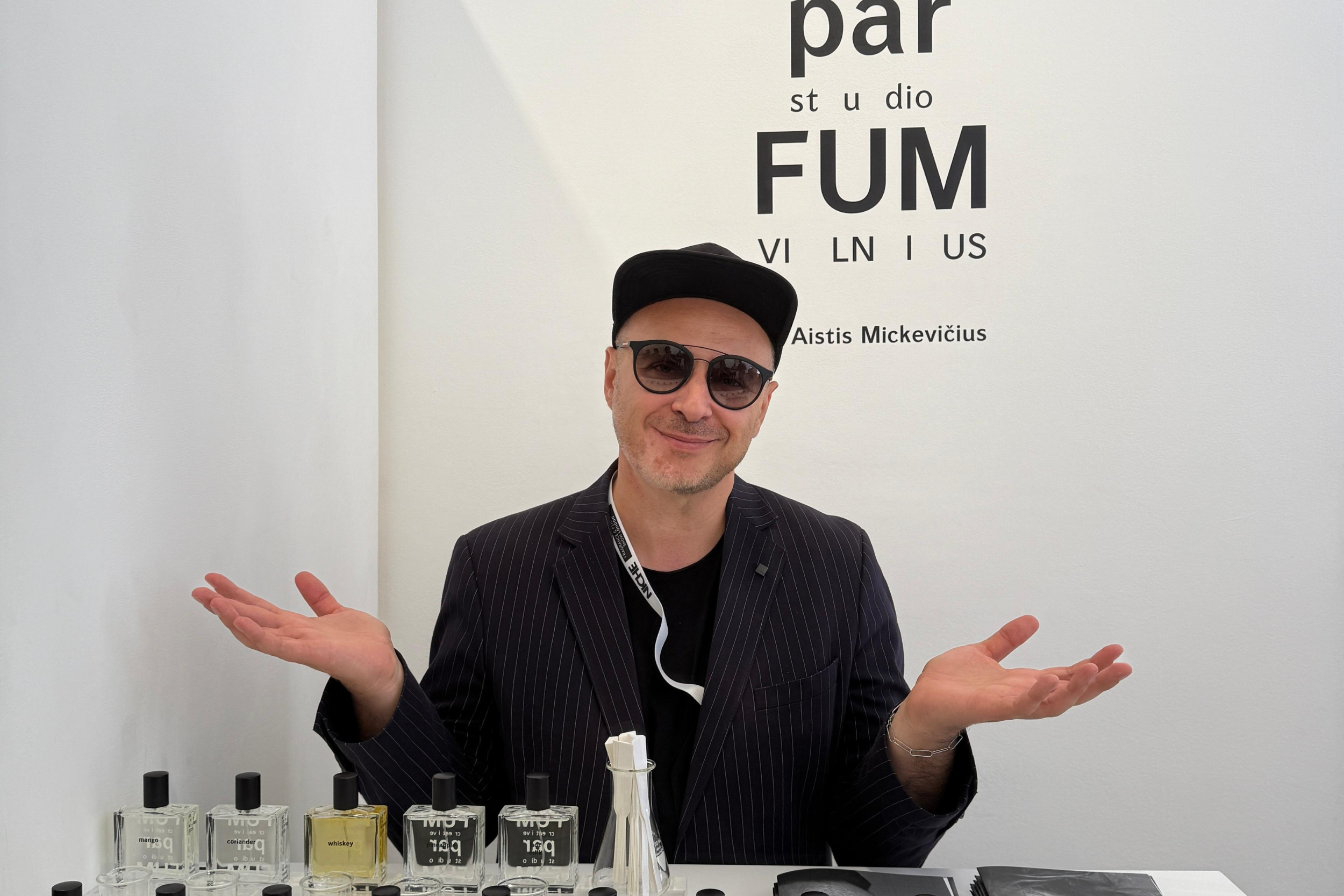
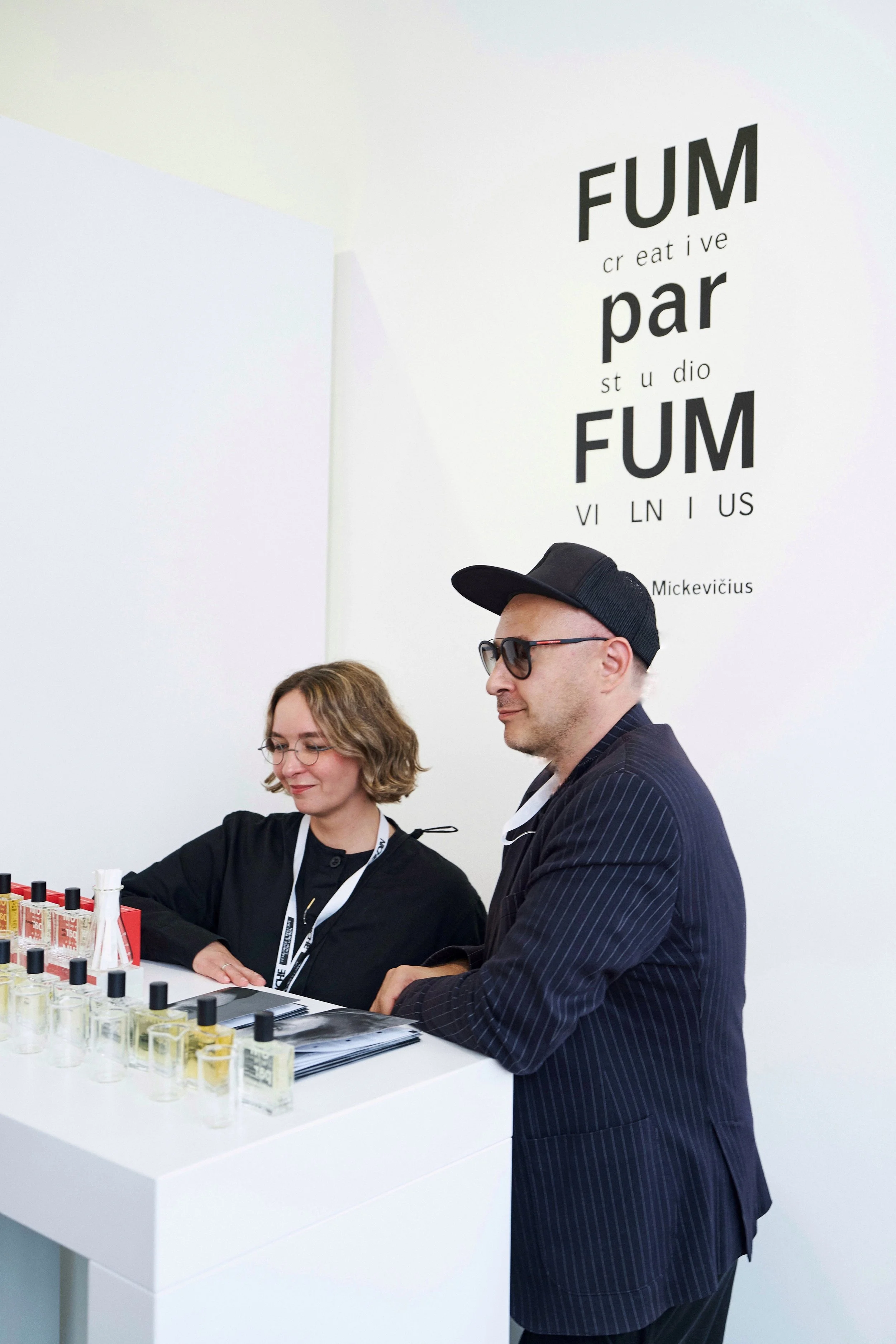
Aistis Mickevicius / Images from the archive of FUMparFUM
Aistis Mickevicius is a name that resonates across both the worlds of fragrance and performance. Known in Lithuania as a celebrated actor, he has also carved a unique path as the founder and perfumer of FUMparFUM, the nation’s first independent perfume brand.
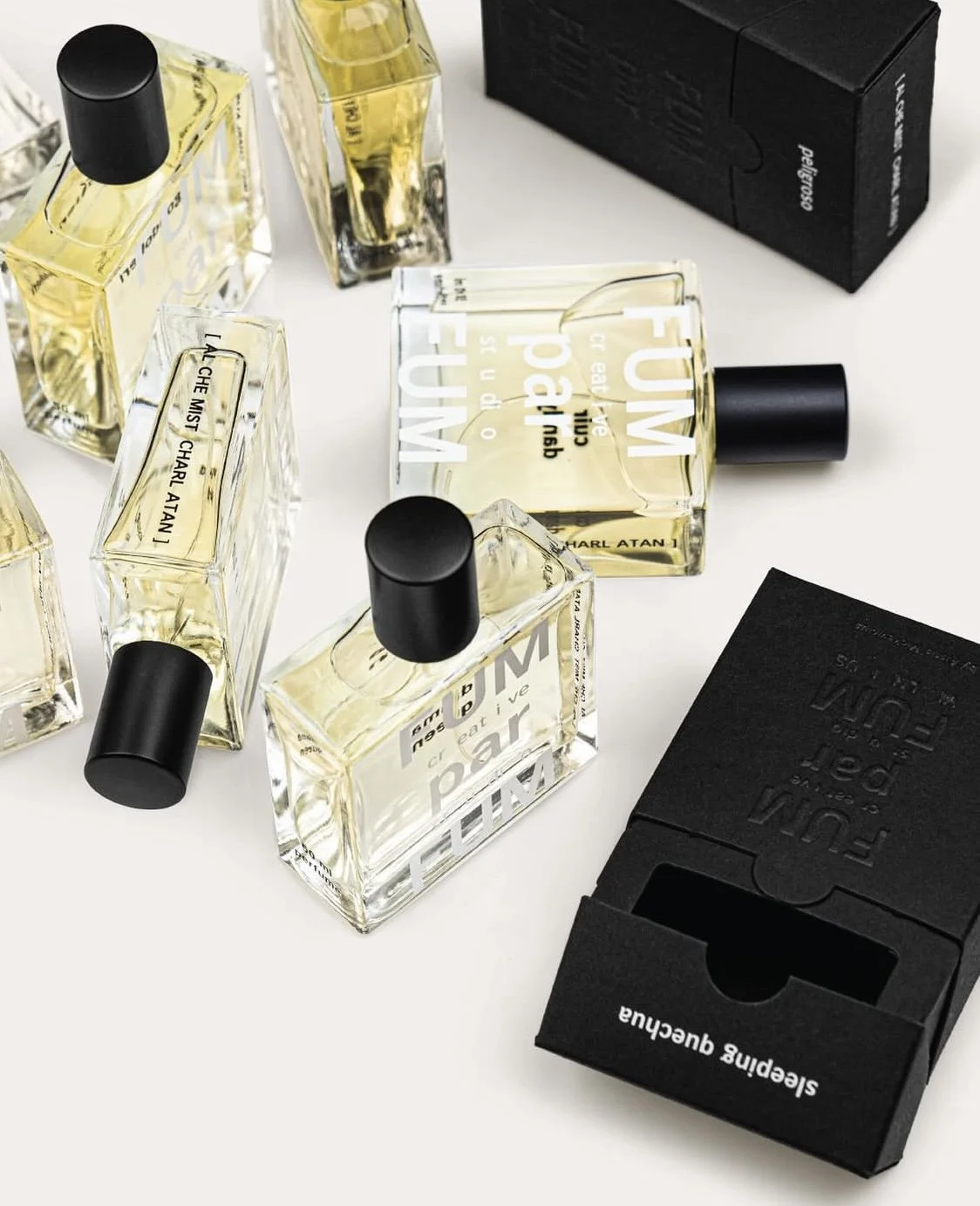
FUMparFUM stands out for its conceptual and avant-garde approach, reflecting Mickevicius’s commitment to innovation and artistic expression. Each fragrance is carefully crafted not merely as a product but as a medium to explore ideas, emotions, and phenomena. In his own words, “For me, a scent can be a gallery object; it doesn’t have to be only a product. I find it very interesting to turn a gallery object into a wearable artwork.”
Mickevicius’s philosophy extends beyond perfumery, blending art, communication, and personal expression. He sees himself not just as a perfumer, but as a scent artist, using fragrance as a means to convey his view of the world. “To me, scent is like an invisible painting – not seen, but smelled,” he explains, emphasizing the poetic and conceptual depth behind every creation.
In an interview for PlezuroMag, we talked about the concept of FUMparFUM, how his acting career influenced the perfumes, and what it really means to introduce perfumes created in a small country to an international audience.
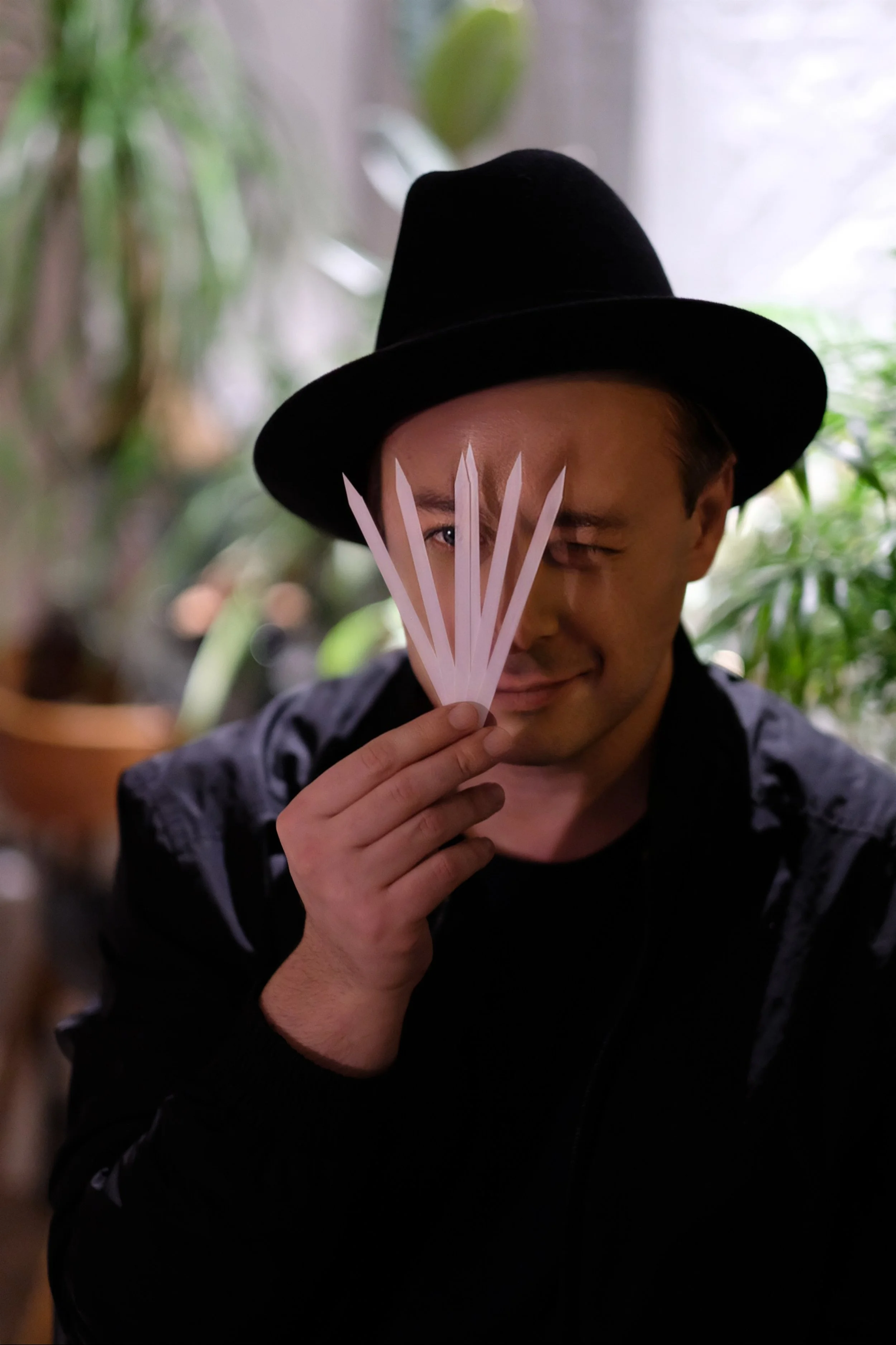
When did you first realize that scent was more than just background for you?
This is a very difficult question. To tell the truth, I don’t know when I realized it. I don’t have one clear answer. It seems to me that these kinds of things are very hard to trace. Somehow, I had never really thought about it deliberately.
But I did realize that scent interested me as an object of exploration a very long time ago. Already in childhood, scents fascinated me – as much as childhood allows one to understand what scents even are.
Do you create scents that reflect your inner states or particular life stages?
I create an authorial, artistic perfume brand, and that means it is very strongly connected to me as an author.
I would be lying if I said that none of these scents are connected to me personally. All of them, in one way or another, reflect my personal experiences – whether professional choices, travel impressions, or inner states. All of my fragrances reflect that in some form.
For example, a perfume Figueres was inspired by a small town in Catalonia where fig trees bloom in spring. But if we look deeper – spring is my favorite season, so that scent also reflects my desire to constantly chase spring.
What, in your opinion, distinguishes a good scent from an interesting one?
A good scent does not actually contradict an interesting scent. And vice versa. The problem arises when the industry takes a scent, puts massive advertising behind it, and then the scent becomes overused. Then its goodness or interestingness simply gets “worn out.”
In niche or high perfumery, a fragrance can be a work that isn’t necessarily meant for everyday wear. It’s similar to beauty – you might say someone looks “interesting,” but that doesn’t necessarily mean classical beauty. With scents, it’s very similar. There are very interesting scents that are not necessarily very wearable, but they still have the right to exist.
For example, Etat Libre d’Orange’s Sécrétions Magnifiques. I find it hard to imagine someone wearing it every day, but within the whole collection it stands out and perfectly reflects the brand’s revolutionary, raw philosophy.
– You are a well-known actor in Lithuania. What do you feel you are more of today – an actor or a perfumer?
– It seems that every day there is less of the actor and more of the perfumer in me. But that’s not a final point. Perhaps in the future other professions will appear as well.
I don’t like forcing myself into a single frame. I greatly respect people who choose one very clear direction and follow it. But it seems to me that there are many universal people who can do many things. Why should they lock themselves into one frame?
As of today, I have almost stepped away from acting, but it still exists within me, and I’m glad about that. At the same time, during this period I discovered that I can write – texts, poetry. And perfumery becomes more and more important in my life with each year.
Did any specific role in your actor career inspire a particular scent?
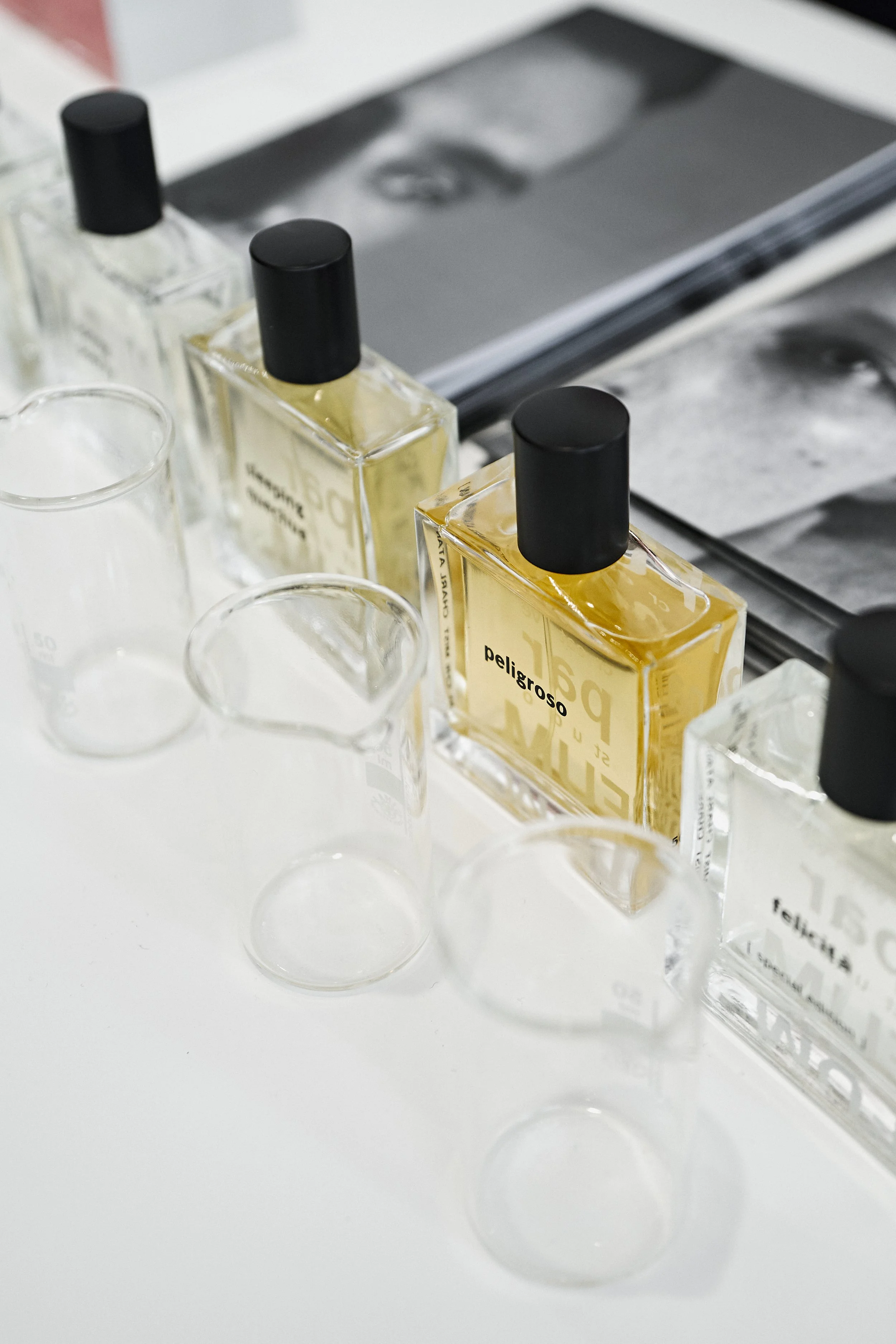
A specific role – no. But the fact that my profession inspired several fragrances is true. One is called Clown, another L’Artiste, and the third Drama Queen. All of them are in one way or another connected to my first profession – acting.
In the case of Clown, there are even more layers. I’ve been fascinated by the circus since childhood. When I applied to the Academy of Music and Theatre, Saulius Mykolaitis [a famous actor and theatre director – editor’s note] told me: “You are a clown from the inside.” And many of my characters are a form of contemporary clowning.
I created L’Artiste after my studies in Paris. For a long time, it seemed to me like the best fragrance I had created – as if I had put everything I knew about perfumery into it at that time. It is inspired by the French song La Bohème and by how Paris appeared to me for a long time – with bohemian artists who tell their stories with their bodies and voices.
Drama Queen is more connected to neorealist cinema. I was very inspired by Anna Magnani – an actress who was extraordinarily dramatic both in life and on screen.
Do you think acting gave you something that most perfumers don’t have?
Yes. I see a very clear connection between theater and perfumery. Both are ephemeral. A performance ends – it no longer exists. The next performance will already be different. The same applies to scent – it evaporates.
Moreover, both theater and scent affect emotional states.
It seems to me that today it’s not enough for a perfumer to have only technical knowledge. They must be very creative. The more different fields one is familiar with, the deeper their creation becomes.
What does your creative routine look like?
My creative routine begins in my head. And that is the longest part of the process. Sometimes I live with an idea for months. It’s not yet a scent, it’s not even a clear structure, but it’s a feeling, a theme, some kind of internal knot that gradually forms.
I think a lot. I like connecting completely different things – images, texts, music, film scenes, memories. It’s important to me that a scent has meaning, that it’s not just a beautiful composition. That’s why by the time I reach the laboratory stage, I’m already very prepared.
The laboratory is like the culmination of the process for me. It’s not the beginning, as people often imagine. It’s already the final stage. I come there with a very clear vision and concrete directions. I don’t like making dozens of trials. I don’t want to experiment chaotically. I want it to work immediately – or at least very quickly.
That requires a great deal of work beforehand. It’s invisible work that no one sees, but it makes up the majority of the creative process.
And what do you do in moments when creativity starts to feel stuck?
Then I simply change creative direction. I never force myself. If I see that scents aren’t working at that moment, I turn to other things.
For example, I write. Poetry, texts. Sometimes I take photos. Sometimes I just walk a lot and observe my surroundings. It’s very important for me not to start blaming myself for “not working.” Because a creative pause is also part of the work.
I’m convinced that creativity cannot be constant. It has waves. There are periods when you create very intensely, and periods when you are more like accumulating material. If you don’t understand that, it’s very easy to burn out.

Is there a scent that best reflects your current life stage today?
Strangely enough, at the moment it would be Chanel No. 5. And that’s a paradox, because it’s not my scent. But I recently worked on a project “Mildazyte” [Edita Mildazyte – Lithuanian journalist, TV presenter, producer – editor’s note], a project about maturity – mature beauty, mature consciousness, a mature relationship with oneself.
Thinking about that, I rediscovered classical perfumery. I realized that classic doesn’t mean boring. It can be endlessly deep, endlessly complex, and very contemporary if you don’t look at it superficially.
It seems to me that over time your relationship with scents changes. First you might be searching for shock or contrast, and later you begin to value balance, silence, structure.
What does it mean to you to create perfumes from Lithuania, rather than, say, Grasse or Paris?
You see, if I were very sedentary and only really focused on Lithuania, it might be harder for me to understand where the world of perfumery is heading – the trends, the directions, the processes that are happening. But since I travel a lot, often for perfumery-related matters – whether it’s fairs, events, or other activities – it allows me to maintain a certain pulse all the time.
It doesn’t necessarily have to be directly reflected in my creations. I mean, it’s not that something becomes popular at a given moment and I feel I have to make a perfume about it. That would be too simplistic. Simply observing these phenomena is already important. And I think that, wherever you are, even in Grasse, you can exist in a very provincial way – or you might not. That’s your choice. Every creator makes their own choices.
To give a Lithuanian example, take a theater director like Juozas Miltinis, who went to Panevezys. You might think, “a province, a small town,” but he had studied in Paris, and yet he went to Panevezys and created a world-class theater there.
So, in this case, being based in Lithuania doesn’t prevent me from observing the world, traveling, and immersing myself in it. Whether I create in Paris or in Vilnius, I don’t think it makes things worse.
Do you think you have to prove yourself more in the international market simply because you are from Lithuania?
Yes, without a doubt. People often raise an eyebrow when you say you’re from Lithuania. Especially in the beginning. When my perfumes began to be represented in a boutique in Paris, they told me very directly: “We chose you because you are exotic.”
On one hand, that helps – you immediately stand out. On the other hand, it means that initially people trust you less. Because Lithuania doesn’t have a strong perfumery tradition; we’re not France or Italy. So you have to prove your value through your work.
But I think that over time it becomes an advantage. Because if you endure, it means your work speaks for itself.
In your opinion, do small countries restrict creativity more, or do they liberate it?
Small countries mean small finances. If we assume that finances can solve many things, then yes, they restrict. Because perfumery requires very large investments: to launch a fragrance, to purchase raw materials, alcohol, packaging, and so on.
A small country is a small market and small finances. But on the other hand, creatively they certainly liberate you. Because you have more interesting themes than a classical perfumer, who often has to travel additionally somewhere to look for inspiration abroad.
For example, in art history there are many cases. Jean-Claude Ellena was invited to create Hermès’ Un Jardin en Méditerranée – he traveled to Algeria, Morocco, and other places to experience gardens, environments, scents. That means it’s not enough to just be in Grasse or Paris – you still need to draw inspiration from elsewhere.
In this case, however, in Lithuania inspiration is more than sufficient, because it’s a completely different cultural, natural, and overall environment. So creatively, I think being from a small region is actually quite good.
What achievements in perfumery are you most proud of?
You know, if I were already some big perfumery star, maybe I could single something out very concretely. But at the moment I’m a small perfumer.
But I’m very happy about the opportunities to show my perfumery to a broader audience. That means countries like Japan, France, Italy, the United States. It’s an incredible opportunity to encounter people from very different cultures and to see and understand their perspectives on perfumery, on scents, and on your own work.
I’m very proud of that – that I dared. Because before that, I was very afraid.
Speaking of Japan: your fragrances receive quite good feedback there. Why do you think that is?
I’ve noticed a very interesting similarity between the Japanese and Lithuanians. At first glance, they shouldn’t really be similar. But some attitude toward nature, toward phenomena, toward life, a certain philosophy – it seems to me that it partially overlaps.
Another thing is that the Japanese have a very specific relationship with scents and scent culture. Historically, they hardly used perfumes the way we imagine. And even today, it’s not that people there use perfumes very heavily.
It was a very pleasant surprise for me that my creation – this so-called middle register – suits them very well.
When people ask me whether my scents are strong, heavy, or light, I always say: they are in between. That middle register. And it turns out that the Japanese really like it.
Moreover, the way the scents develop on their skin and on their clothes suits them very well. It seems to me that in this case, our philosophies simply aligned.
And the final question: where do you see FUMparFUM in ten years?
I see it as an international brand that continues to carry the flag of artistic perfumery.
Because if you look at perfumery purely as a business, then the most important things are numbers: sales, profit, and so on. But my mission is somewhat different. I understand perfumery as a form of dissemination.
That means spreading artistic ideas through scent. I understand that this cannot guarantee very high sales or commissions, but I really like this direction, and I intend to stick to it.
It seems to me that this direction has great potential in the future of perfumery. Just as we have selective champagne or other selective products, perfumery can also be a selective thing.