From Japanese Scented Ink to Modern Perfumery: The Story of EDIT(h)
Written by Kristina Kybartaite-Damule
A Japanese perfume brand EDIT(h), founded by Kentaro Kuzuwa, has its roots in a family business that has been producing scented inkpad for over a century. Kuzuwa, the sixth generation to join the company, brought this olfactory heritage together with his own background as a music director, creating a perfume house that explores Japanese identity through a distinctly contemporary lens.
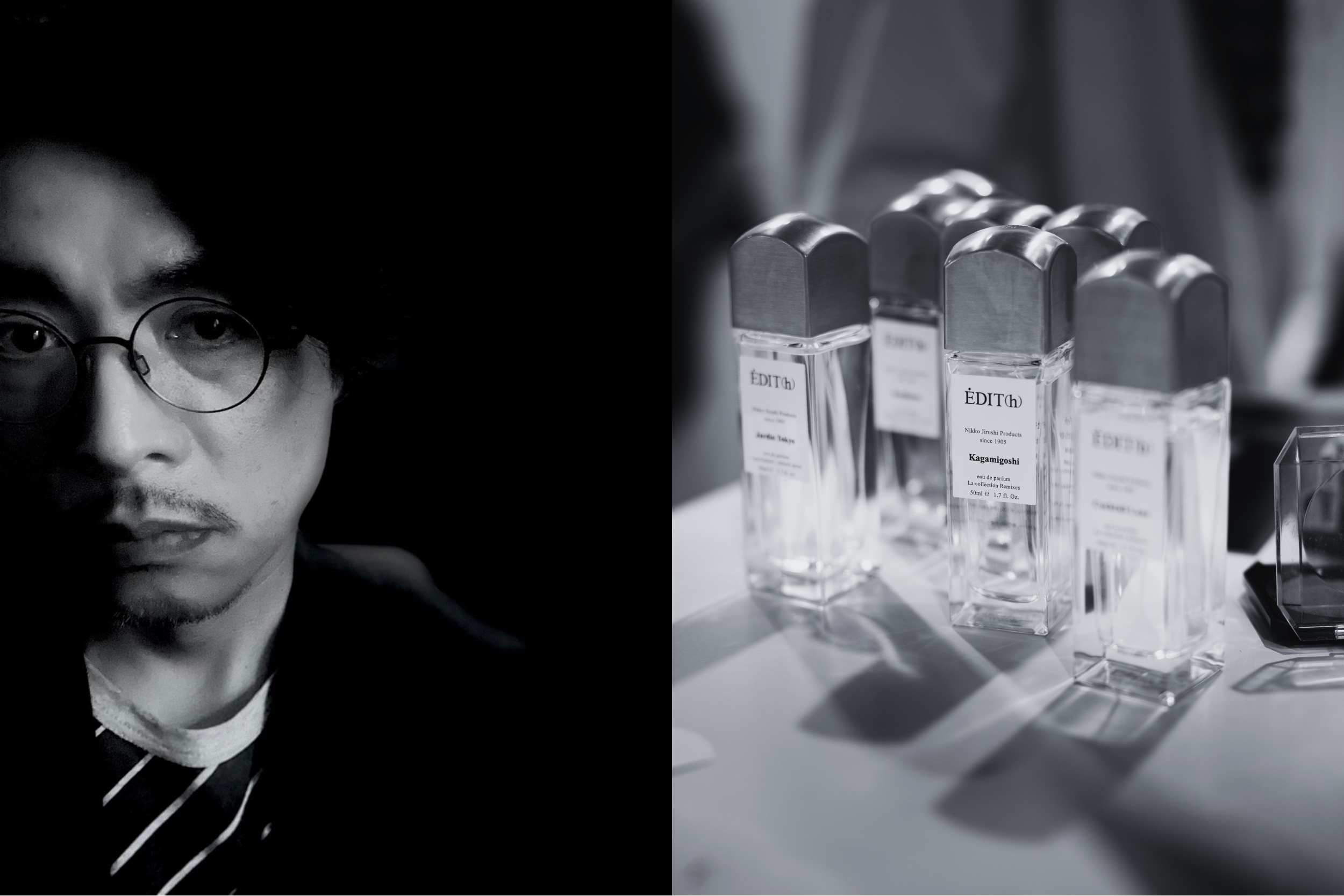
Kentaro Kuzuwa / EDIT(h) | Photo credits: personal album / Darius Damulis
EDIT(h) is not interested in simply reproducing the conventions of French perfumery or presenting a predictable interpretation of what “Japanese perfume” should smell like. Instead, the brand experiments with fragrance structures, atmosphere and the feelings the scents create. Its collection moves between green, woody, leathery and tea-infused compositions, often with a sense of restraint and refinement, while remaining focused on creating a distinctive olfactory signature.
In the international perfume fairs, like Esxence in Milan, where I first met Kentaro Kuzuwa, EDIT(h)’s approach immediately stands out. Behind the fragrances is a fascinating story of cultural heritage, creative direction and the practical challenges of bringing a Japanese perfume brand to the international market.
In our interview for PlezuroMag, we spoke about the family tradition that ultimately led Kuzuwa to perfumery, how his experience in music influences the way he works with perfumers, and why he chose to challenge the conventional rules of fragrance composition. We also discussed the evolving perfume culture in Japan, the differences between Japanese and European fragrance consumers, and what Japanese luxury means to him.

Kentaro Kuzuwa / Photo from a personal album
You come from a family that has been producing fragrant inkpad for generations. Could you tell us more about your background and how this heritage influenced your path?
Before joining my family business, I was a music director in my twenties. My family company had already been working for over 100 years, and I joined the business as the sixth generation during its 100th anniversary.
The company traditionally produced only ink-related products. I learned the craftsmanship management from the fifth generation and worked with masters for over ten years, learning the techniques and manufacturing process.
At the same time, I gained experience in directing and coordinating creators through my work in the music industry. I combined these two specialties—the craftsmanship of my family heritage and the ability to direct creative processes—and brought them together through perfume creation.
Would you say EDIT(h) is a continuation of your family heritage?
Yes. When I took over from the fifth generation, I always thought about how to innovate our techniques, legacy, and history.
Traditional businesses are declining everywhere, and Japanese stamping culture is also becoming more difficult to sustain as a business. I felt that I needed to discover what was truly unique about our heritage: what was special, what represented our professionalism, and what could continue into the future.
I discovered that uniqueness in scent.
Usually, red ink used for traditional seals does not have a specific fragrance formula. But throughout our long history, we have continued to create scented stamp ink, cultivating a unique olfactory identity of our own. That became the foundation of EDIT(h).
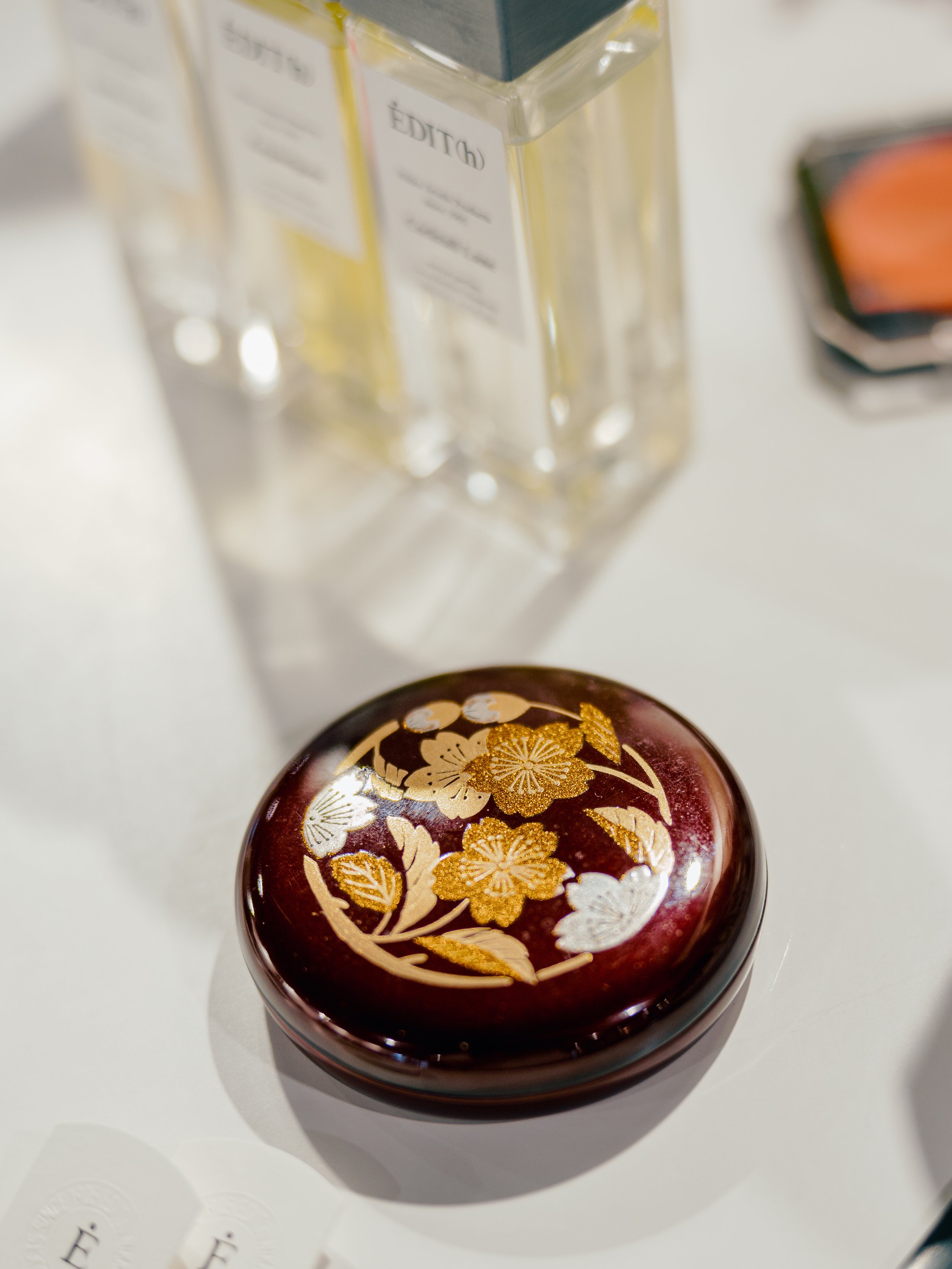
Photo credit: Darius Damulis
Before perfume, you worked in music. How does music influence the way you create fragrances?
My experience in music influenced my role as a director.
A music director works with musicians, guiding creators toward the final result. A perfume director works with perfumers in the same way.
The perfumer and musician are both artists and creators. My specialty is bringing together their skills and guiding the creative process toward the right answer.
EDIT(h) does not follow conventional perfume structures and does not simply imitate French perfumery. You don’t follow the traditional top-heart-base structure. Why did you decide to challenge these established rules?
Perfume culture originally comes from France. If we simply followed the established rules of perfume creation, I felt that French perfumery would always be better than us because they created those rules.
So I wanted to create a new method by combining my experience in music direction with my own feelings and intuition.
French perfumery has a golden rule: the balance between top, middle, and base notes. I wanted to break that rule and focus instead on the overall feeling and atmosphere of the EDIT(h) fragrance.
From the beginning, was your ambition to create a global fragrance brand rather than only a Japanese brand?
Yes, from the beginning I wanted to create a global brand.
However, there was a practical challenge. The Japanese cosmetic industry has a very long history—over 100 years—and because of that, Japan developed its own unique regulations and standards.
Many small and medium-sized Japanese factories have existed for generations, but their production systems were created according to Japanese regulations rather than international standards. This made exporting Japanese perfumes to Europe difficult.
Many countries whose cosmetic industries developed more recently, such as South Korea, Thailand, Indonesia, and China, the industry has evolved under modern regulatory frameworks that were largely modeled on European standards. Their factories often already had international certifications such as ISO.
When I launched EDIT(h) in 2018, I did not fully understand this challenge. I participated in exhibitions and received positive reactions, but I discovered that the product could not easily be registered in Europe.
Therefore, in 2022, I created EDIT(h) as a Made in France product specifically for the European market. But the only difference is whether the product is made using alcohol sourced from Europe or from Japan. In every other respect—including the product labels—it is exactly the same as the Japanese-made ÉDIT(h) product. From 2026, our Japanese factory obtained ISO certification, and now we are able to register and introduce Made in Japan products.
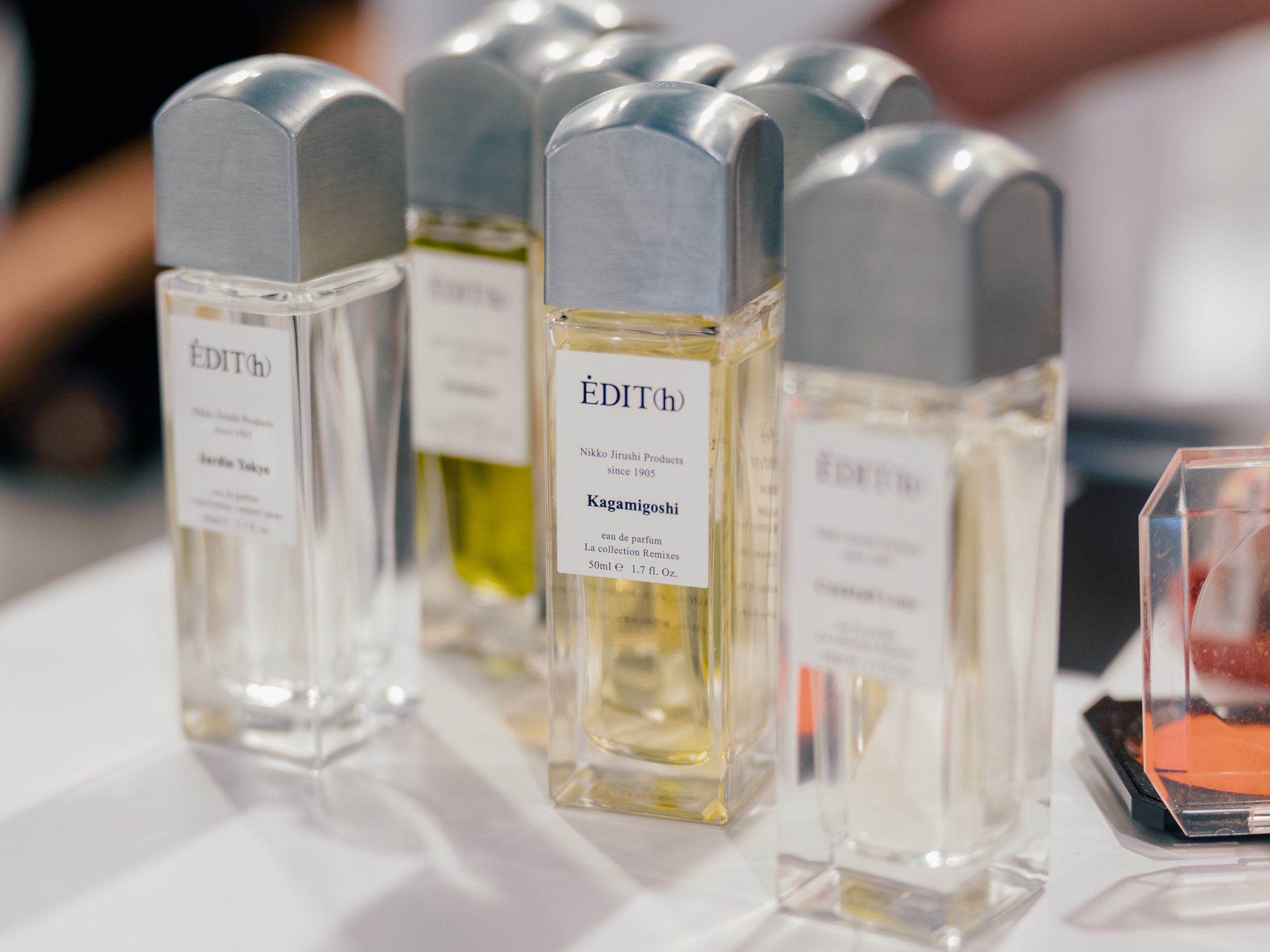
Photo credit: Darius Damulis
You work with Japanese perfumers. How does their approach differ from European perfumers?
The first and third collections were created with Japanese perfumers. The second collection was a remix created together with European perfumers.
When we started the second collection, French perfumers became very interested because the concept and method were something new for them. It was not simply a French approach—it was a reworking of an original idea into another original creation.
My role with Japanese perfumers is very direct. I discuss and guide the creation process closely. In my personal opinion, the technique and experience of Japanese perfumers is still developing compared to French perfumers, so I often push further: changing ingredients, adjusting directions, and exploring different possibilities until we reach the final scent.
Working with Japanese perfumers takes more time because it is about creating something completely new.
French perfumers have a different method. Their mission was to remix and reinterpret existing ideas. Their work is extremely smart and efficient—the first proposal is already very high quality. However, when I want to make small adjustments, the discussion process can sometimes be challenging.
What does Japanese luxury mean today? Is it different from the European idea of luxury?
This is a big question.
Of course, Japan also considers brands like Louis Vuitton or luxury hotels such as Park Hyatt to represent luxury.
But traditionally, Japanese culture has a different feeling about becoming wealthy. In some cultures, becoming rich is associated mainly with enjoying beautiful things. In Japanese tradition, if you become successful or wealthy, there is also an expectation that you give something back to others.
There is a feeling of not being too excessive or overly glamorous.
For me, Japanese luxury is slightly different from European luxury. In the Japanese view, luxury earns true respect only when it is rooted in moral integrity, intellectual sophistication, and spiritual depth.
Are there scents from everyday Japanese life that deserve more attention internationally?
I think traditional Japanese incense and the scent of our ink are important examples.
These traditional scents are no longer part of everyday life for most Japanese people, especially in urban areas. Yet they remain deeply embedded in our collective cultural memory. For some, they recall their hometown; for others, festivals, shrines, or Buddhist temples.
The ingredients themselves are not necessarily rare in modern perfumery. But the important thing is the feeling behind them.
When I say “this is Japanese,” it is not only about the ingredient—it is about the emotion and cultural connection.
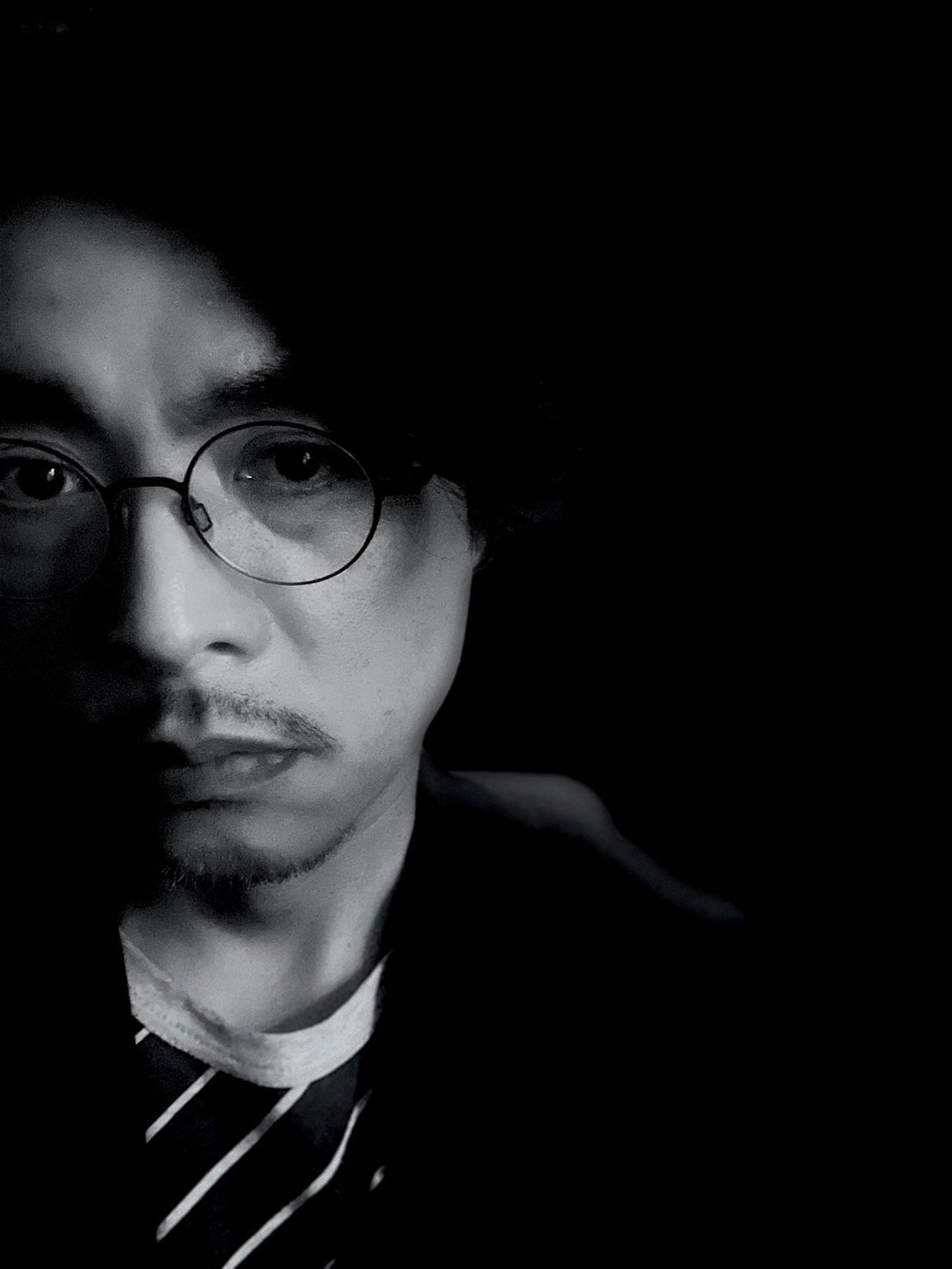
Photo from a personal album
Is perfume becoming a stronger form of personal expression in Japan, especially among younger generations?
Yes, perfume culture is growing in Japan.
I see many Japanese perfume professionals and many Japanese perfume lovers who know a lot about fragrances and collect perfumes.
The biggest difference between European and Japanese perfume lovers is how they approach wearing fragrance.
European perfume lovers often think: “I have perfume, I can wear it now.” They don’t necessarily overthink it.
Japanese perfume lovers want to understand everything: How many sprays are correct? Where should I apply it? Should I spray on my skin or clothes? They want to know the proper way.
Perfume is becoming more popular in Japan, but consumers are still developing their understanding as perfume users.
Japan is often associated with subtlety and restraint in scent. Do you think this limits creativity or encourages originality?
Personally, I do not think about whether a fragrance should be subtle or strong. I simply create what feels right for EDIT(h).
Many creators have their own philosophy.
Japanese consumers are also diverse. Some people like stronger fragrances. Others prefer very light scents.
Japan has a population of over 100 million people, so there are people who love powerful fragrances and people who prefer subtle ones.
However, because Japanese culture places great importance on consideration for others, many people tend the way to avoid wearing fragrances in a way that could be perceived as too strong or potentially unpleasant to those around them.
How are EDIT(h) fragrances received differently in Japan compared to Europe?
EDIT(h) fragrances are not designed to have extremely strong projection. They are balanced: beautiful on the skin, with good longevity and a refined presence.
Regarding differences between markets, reactions depend on the country.
In France, people respond very well to the green fragrances, such as Jardin des mots, Jardin Tokyo, and Green Velvet.
In the Netherlands, green notes are also appreciated.
In Italy and England, people often prefer woody and leather fragrances, such as Kagamigoshi and Club Lonely.
Tea notes are popular both in Europe and Japan.
So it is not only about Europe versus Japan—the reaction changes from country to country.

Photo credit: Darius Damulis
Where do you see EDIT(h) in five years?
From this year, a new chapter for EDIT(h) begins: bringing Made in Japan products to the European and global markets.
We will continue developing partnerships with European and international distributors, retailers, and stores.
My goal is for EDIT(h) to become recognized as one of the great fragrance brands from Japan.
Many Korean and Chinese brands are growing quickly and expanding internationally, but our company is very small. However, we are authentic and focused on creation.
We will continue growing step by step, building the identity of EDIT(h).
In five years, I hope more people around the world will discover the beauty of EDIT(h).
Thank you for your time.