The Queen and the Viper by Stéphane Humbert Lucas: Where Ice Meets Fire
Written by Nina Hellström
Stéphane Humbert Lucas is one of the houses that continues to focus on creating unique fragrances rather than producing commercially safe releases designed to appeal to a wide audience. Although the house has two main collections with their own distinct olfactory profiles, both contain many scents heavily influenced by Arabian culture. The house explores every major fragrance category, and each creation is crafted in a way that is instantly recognizable as Stéphane Humbert Lucas.
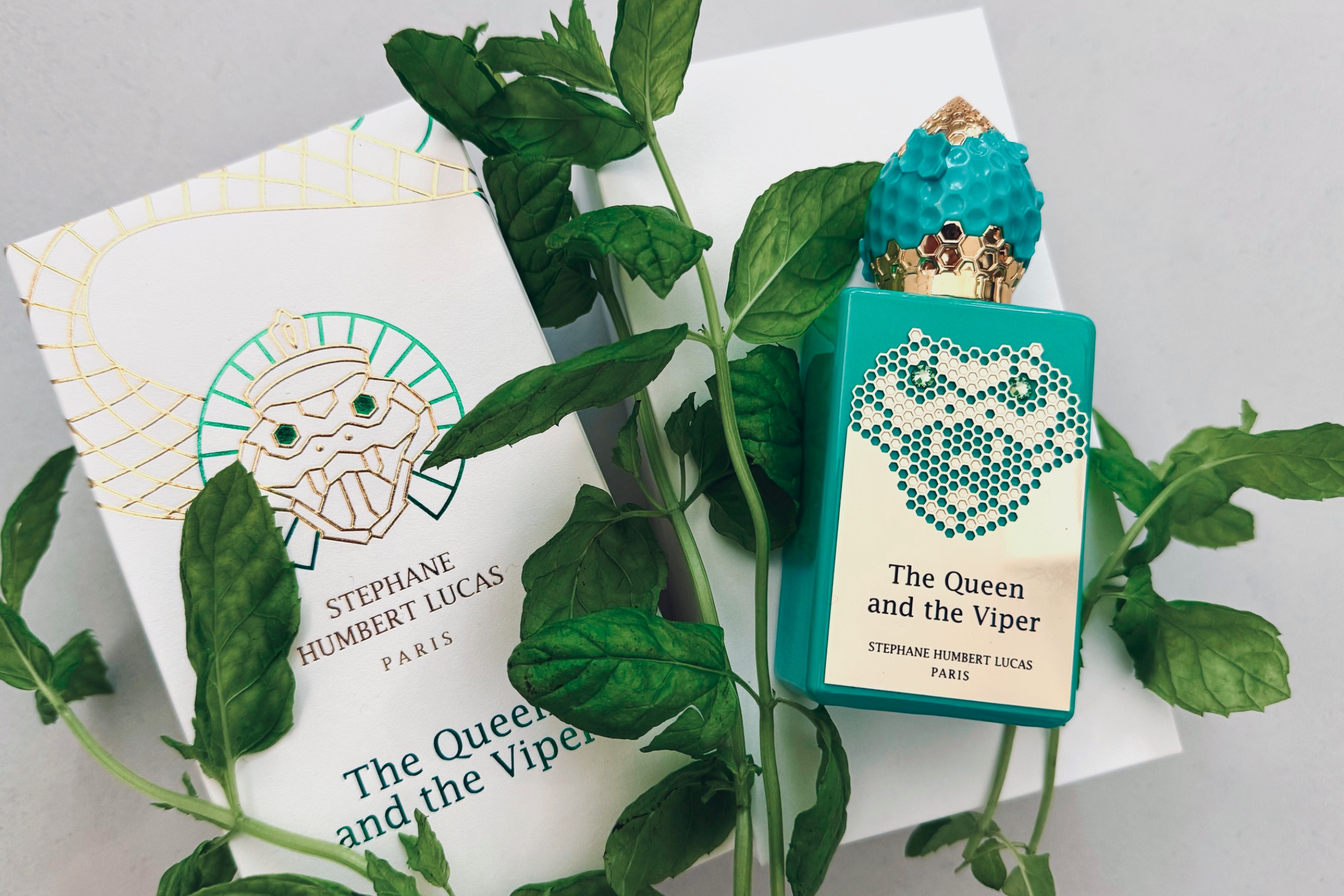
Images by Nina Hellström
The Queen and the Viper is the latest fragrance in “The Snake Collection”, where the vibrant and striking bottles immediately introduce the story behind each scent. The primary creative force driving this collection is myth and mystery, capturing the duality of the serpent as both a symbol of danger and divine beauty. In general, these fragrances are bold, and their note combinations are often more unconventional and rule-breaking than traditional compositions, although I think there are some extremely approachable scents among them.
This newest “snake” is characterized by its striking paradoxical contrast between cold and warm elements, with mint as its central focus. Mint is a highly versatile note that brings a crisp, cooling, and herbaceous quality to perfumes. It is often used in Fougère-style fragrances, green and aquatic compositions, and the most common fragrance family it is paired with is citrus. The Queen and the Viper opens with an incredibly realistic, almost icy green freshness typical of mint, combined with bright, zesty citrus notes. However, its uniqueness is immediately apparent, as Frankincense and Styrax introduce a deep resinous texture and a delicate smoky veil over the freshness. Those familiar with Stéphane Humbert Lucas’s fragrances will immediately recognize that this belongs to the house, while those discovering it for the first time will certainly experience a memorable olfactory impression.
Styrax is not leathery or animalic here, nor does it create a vanilla-like sweetness. Instead, it brings a soft, sweet warmth, which is also present in the development of Frankincense. Both notes have a decisive influence on the texture and character of the fragrance - much more than one might expect from simply looking at the opening notes. Because Frankincense is not a single molecule, but a complex natural resin made of hundreds of different compounds, the size of its molecules generally vary a lot. Therefore beside its tiny, highly volatile molecules, its heavier fixative components together with the highly tenacious molecules of Styrax, help support the mint accord. Despite this, the mint fades considerably during the first hour, and some may feel that it should last stronger longer - the contrast created by the opening is simply that fascinating.
If the opening is a fireworks display of contrasts, the heart of The Queen and the Viper moves toward a more traditional mint composition. Clary sage complements the herbal character of mint and davana from the opening, while Osmanthus introduces a soft sensuality to the fragrance. Both Jasmine and Vetiver play a more important structural role than a clearly identifiable olfactory one. I think the heart is well concealed by the powerful opening and the base, which is not particularly complex but is highly effective in completing the character of the fragrance and enhancing its longevity.
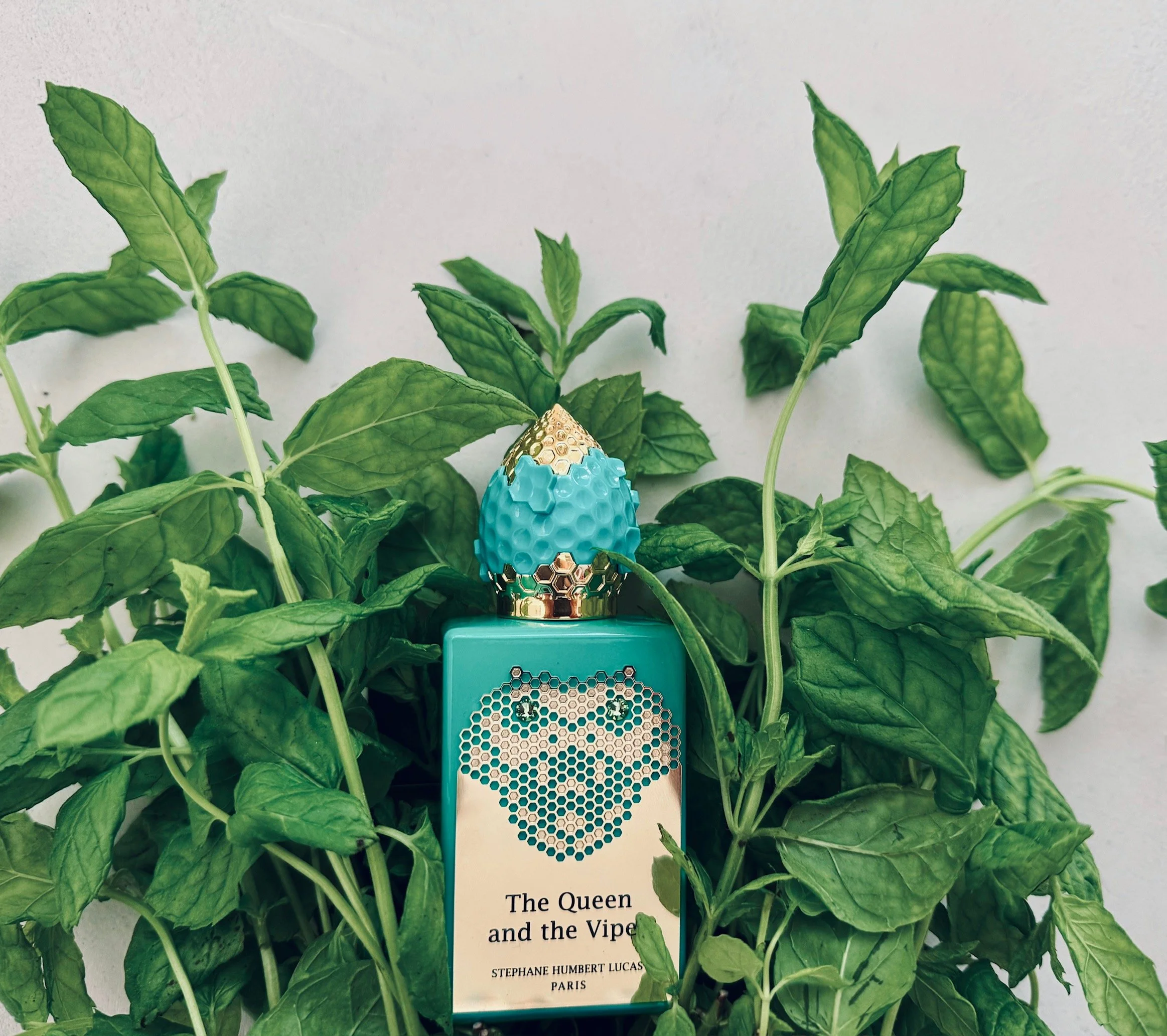
The base uses Hydrocarboresine, a specific commercially produced natural derivative of cistus-labdanum. They are closely related and share many olfactory characteristics, but they are not identical. Hydrocarboresine is a cleaner, intensely incense-like, woody, and smoky interpretation of Labdanum with remarkable staying power. Blond Tobacco should also not be confused with heavy, dark, smoky tobacco. Instead, it is delicate and refined, bringing a luxurious soft warmth and elegant depth to the composition. It is also worth mentioning that Date does not present itself as the strong, thick, sticky sweetness that it can often have in many perfumes, but rather as a sophisticated and subtle note that adds a gentle touch of sweetness.
The Queen and the Viper is carefully constructed, well-blended creation where notes that typically create a distinct smoky or leathery impression are used instead to form an extremely rare Stéphane Humbert Lucas’s recognizable resinous signature. The individual notes that create this, vary from fragrance to fragrance, with Incense being one of the most frequently used, yet they all share a highly distinctive and inevitably divisive texture that has attracted both devoted admirers and strong critics. It reminds me of burning sand in the desert - a hot, warm, softly smoky sensation (Crying of Evil, God of Fire, Harrods H Mamba, Sand Dance, Soleil de Jeddah Afterglow, Ô Hira, Wish Come True), and sometimes a similar effect expressed in a more figuratively cold way (Black Gemstone, Mortal Skin). When mint and greenery are added to this already unusual style, the result becomes something extremely rare.
The Queen and the Viper represents Stéphane Humbert Lucas at its most distinctive - a fragrance built around contrasts rather than a traditional progression from top to heart to base. The icy clarity of mint, the warmth of resins, and the soft sweetness of Blond Tobacco and Date create a composition that feels both familiar and completely unexpected. It is not a fragrance designed to disappear into the background, but rather one that asks the wearer to appreciate texture, atmosphere, and the emotional effect of a scent. While the unusual combination of freshness, smoke, and resinous warmth will undoubtedly divide opinions, it is precisely this refusal to follow predictable formulas that makes it memorable. The Queen and the Viper demonstrates why Stéphane Humbert Lucas remains one of the more recognizable voices in contemporary niche perfumery.